The exact origin of the German cuckoo clock is unknown, but records suggest that the first primitive clocks date back to the mid-17th century.
The story goes that clock making began around 1630 in the Black Forest, where people had always crafted and carved wood during the long, cold winters. A peddler who sold glass from the Black Forest to foreign countries is said to have returned from his travels with a clock, perhaps from Böhmen (Czech Republic). The local people must have been fascinated by the technical wonder of the clock, which kept much better time than an hourglass or sundial, typically used to tell time then in the region. So the tradition of clock-making began!
The First Clocks from the Black Forest
Most of the people who made clocks were not rich farmers, but ’Häuslers’, who owned no land and had to work for other farmers to survive. Clock-making was a way for them to earn some extra money during the long winter months. Over time, clock making improved. Carvers, carpenters and painters brought specialized skills to the evolution of the hand-made craftsmanship.
Some clocks even included ornamentation like turning figures. In 1738 Franz Ketterer from Schönwald was the first to build a cuckoo into his clocks.
The Cuckoo Clock
Franz Ketterer was a clock maker who, inspired by the bellows of church organs, started incorporating the cuckoo’s sound into the clocks.
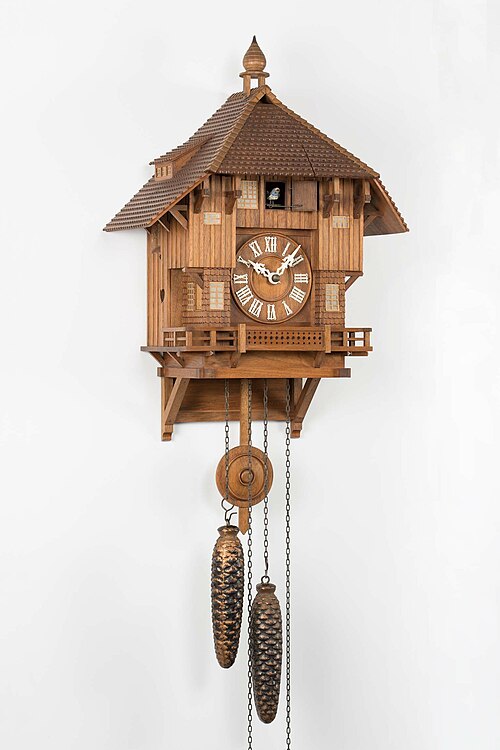
The ‘coo coo’ sound is derived from a system of bellows pushing air through two wooden whistles to recreate the distinctive two-note call of the common cuckoo. The gears are regulated by a pendulum and a system of two or three weights, traditionally shaped like pinecones, that steadily drop over a period of time, either a day or a week. One of the weights keeps the gears running while the other controls the bird’s movement in and out from behind its door. The cuckoo was presumably chosen for the clock since its song has always served as a harbinger of spring and warmer weather.
Although the functionality of the cuckoo clock has not changed much since its inception, today there are many designs. The most common cuckoo clock styles are the traditional style and the chalet style. The traditional style features wildlife and natural carvings typical for the Black Forest. The chalet style is associated with animated characters like woodchoppers, bell-ringers, and beer steins. There is also a clock version know as the railroad clock. These clocks date back to around 1860 when many tunnels were being built through the Black Forest to create new railroad connections. Skilled tunnel-builders from Italy came to work in the tunnels and brought their way of life and architecture with them. In addition to tunnels, the Italians also built railroad station houses. They adorned the houses with grapevines from their homeland. This motif was also reflected in cuckoo clocks made during the period.
The Cuckoo Clock Today
Today cuckoo clocks exist in many shapes and sizes. Some are even battery-driven, but a genuine cuckoo clock is still hand-made and only produced in the Black Forest according to traditional techniques.
Sources: