Who Was Nicolas Herkimer?
Nicolas Herkimer was the eldest son of German immigrants Johann Jost Herschheimer and Catherine Petrie. He was born in the Mohawk Valley of New York in circa 1728 and died in the Revolutionary Battle at Oriskany in upstate New York on August 16, 1777. He was said to have known German, English and understood some Iroquois languages. The Mohawk Valley was home to many Iroquois tribes.
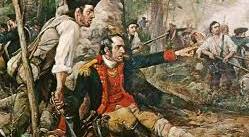
General Herkimer at the Battle of Oriskany
Source: American Battlefield Trust
Herkimer’s Military Engagement
Herkimer’s first military endeavor was during the French and Indian War, where he defended his town of German Flatts. He was made a captain and was later promoted to lieutenant by the end of the war. He was a member of the district militia in Tryon County, which split its loyalties between the Crown and Patriots. When Crown loyalists withdrew to Canada, New York’s Provincial congress made Herkimer the brigadier general. In June of 1776, Herkimer led 380 militiamen to meet with the Mohawk leader Joseph Brant. Here Herkimer pleaded that the Iroquois take a neutral stance in the revolution, but Brant insisted that their loyalty was to British King George the Third.
In 1777, when Herkimer heard of the British siege of Fort Schuyler, west of Tryon County, he assembled his militia at Fort Dayton and proceeded westward to Fort Stanwix. His troops were unexpectedly ambushed by a group of British soldiers, Tory militia and Mohawk Indians on August 6th, 1777. This assault, known as the Battle of Oriskany, was one of the bloodiest battles of the Revolutionary War.
Herkimer was severely wounded in the leg during the battle. Legend has it that his troops removed him to the shade of a tree. From this point he continued to command his troops…while smoking a pipe! Following a botched amputation of the injured leg, Herkimer died 10 days later.
Herkimer did not manage to relieve the fort, and lost many troops in the battle. But the result was that British troops were demoralized by raids and the Mohawks abandoned the siege entirely. The Iroquois Confederation had a lasting fallout as a result.
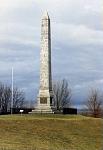
Oriskany Battle Monument
Source: Smithsonian Art Inventories
Today Herkimer County New York is named after Nicolas Herkimer. His nephew, John Herkimer, later became a U.S. Congressman. Two streets in Brooklyn and the Bronx are also named for the Revolutionary War hero.
Oriskany Battlefield Park
One-hundred and seven years after the Battle of Oriskany, an obelisk was dedicated to this historical event on August 6, 1884. The battlefield received formal protection from the state of New York forty-six years later in 1927, on the date of the battle’s sesquicentennial. Initially the park was comprised of five acres, but today it covers 70 acres, with the Erie Canal as its northern border. The obelisk stands on the ground where the wounded Herkimer led his troops from under the shady beech tree.
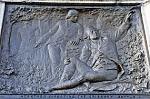
Plaque from the Oriskany Battlefield Park
Source: Smithsonian Art Inventories
Sources: